
In water treatment plants, whose goal is to produce potable water or industrial water, clarifiers are primarily used to remove suspended particles, turbidity, color, and organic matter from raw water (such as river or lake water). The most common types of clarifiers in these treatment plants include:
- Sedimentation Basins:
- Function: After the coagulation process (adding chemicals to clump small particles together) and flocculation (forming larger particles or flocs), the water enters these basins. In these basins, the water flow is significantly slowed down, and the formed flocs, due to their weight, slowly settle at the bottom of the tank.
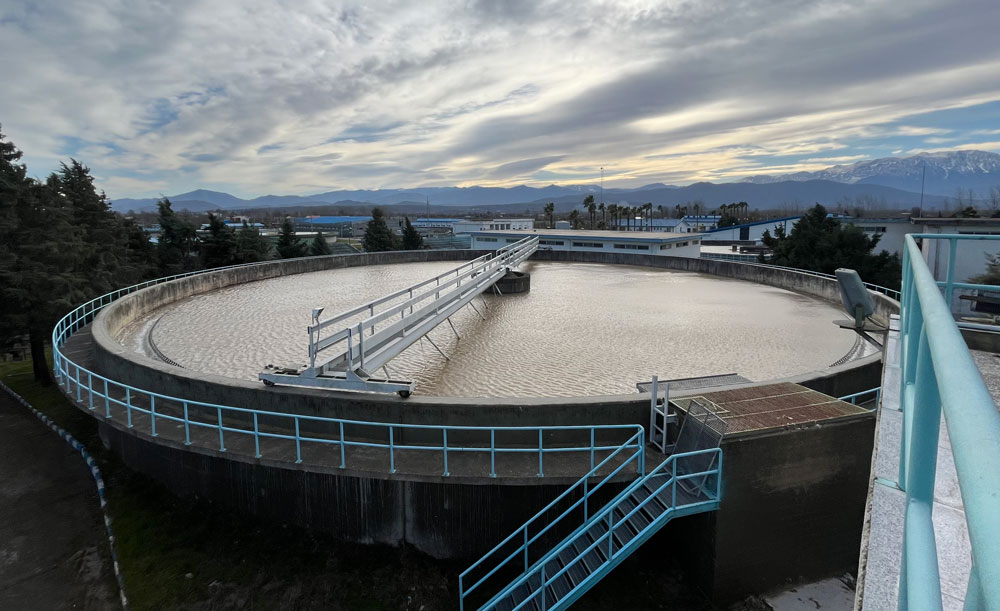
- Structure: They are usually large rectangular or circular tanks. A sludge collection system (which consists of the settled flocs) is integrated at the bottom.
- Application: A fundamental stage in most water treatment plants for removing a significant portion of suspended solids.
- Inclined Plate / Lamella Clarifiers:
- Function: These types of clarifiers consist of a set of inclined plates or blades installed at a specific angle to the horizontal. The treated water (after coagulation and flocculation) passes through the spaces between these plates. Suspended particles collide with the plate surfaces and, due to the slope of the plates, slide downwards towards the sludge collection system.
- Advantages: Due to the increased effective settling area within a smaller volume, they have higher efficiency compared to simple sedimentation basins and occupy less space.
- Application: Suitable for treating high volumes of water or when space is limited.
- Rapid Clarifiers / High-Rate Clarifiers:
- Function: This term more broadly refers to the overall treatment process that includes rapid coagulation, flocculation, and sedimentation. The clarifiers used in these processes are often a combination of high-efficiency sedimentation basins, sometimes equipped with filter layers at the bottom or top (such as pressure filters or flotation filters).
- Example: Some types of pressure filters that perform both sedimentation and filtration simultaneously.
- Air Flotation Units (DAF):
- Function: Although not “sedimentation,” DAF is an effective method for removing solids lighter than water (such as fats, oils, or some algae). In this process, compressed air is injected into the tank as very fine bubbles. These bubbles attach to suspended particles, bringing them to the surface of the water, where they are collected as foam and removed.
- Application: Primarily used in wastewater treatment or certain specific industrial water treatments, but may also be used in some water treatment applications.
Key Point: In water treatment plants, the coagulation and flocculation process before entering the clarifiers is crucial. This stage causes colloidal and colored particles, which do not naturally settle, to form settleable flocs. After the clarifier, a filtration stage (such as sand filters) is usually performed to remove remaining particles and achieve final water clarification.